
INTELLIGENT REGENERATIVE BRAKING
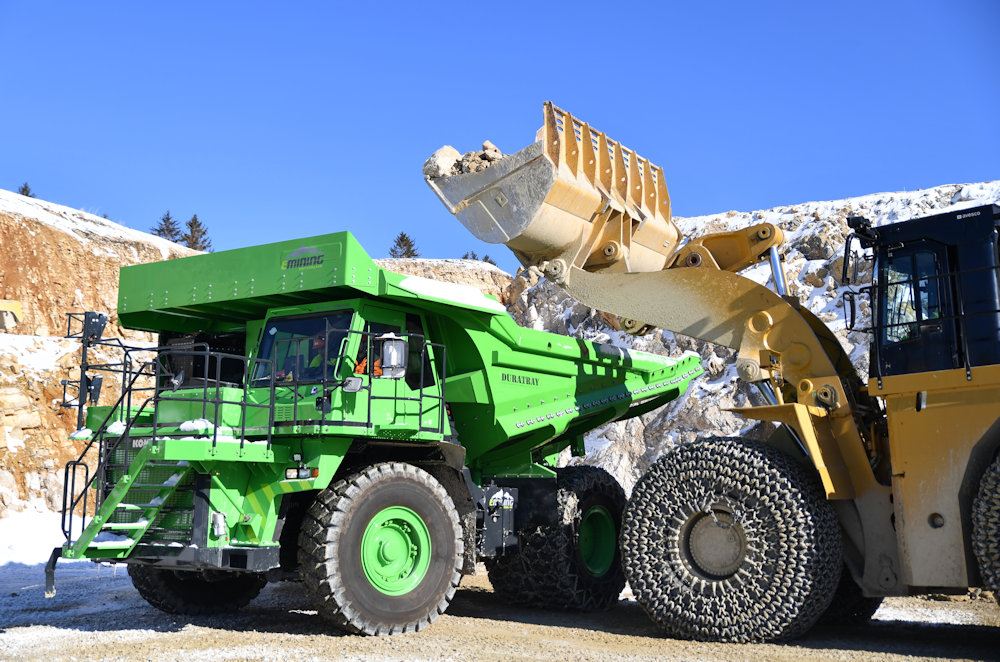
INTELLIGENT REGENERATIVE BRAKING for Electric Mining Trucks
Recover more energy. Brake safely. Use the entire power flow intelligently.
Ein innovatives Verfahren zur intelligenten Steuerung und Verteilung der Bremsleistung bei schweren elektrisch betriebenen Muldenkippern. Sichere Geschwindigkeitsregelung wird mit einer konsequenten Nutzung der verfügbaren elektrischen Bremsleistung verbunden.
The Challenge:
In heavy mining vehicles, fully loaded downhill driving generates enormous amounts of energy. At the same time, the vehicle must be safely maintained at a defined speed. The challenge is to recover as much braking energy electrically as possible without overloading the battery, generator, inverter or mechanical brake. The focus is on a better CO2-footprint, increased fleet efficiency and reduced Total Cost of Ownership (TCO).
Such vehicles are already available on the market, but efficiency is lacking in the allocation of regenerative braking power.
The New Solution:
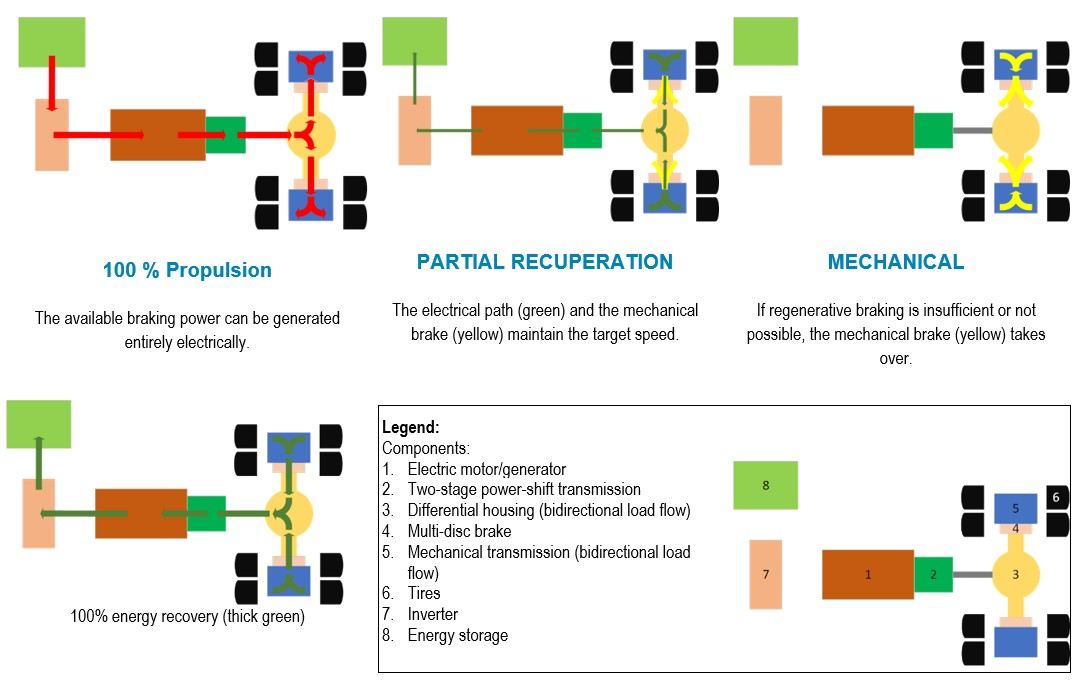
A central control unit continuously determines the maximum regenerative braking power currently available and allocates the required total braking power between the electrical and mechanical brakes according to demand.
Factors that can be taken into account include road gradient, total vehicle weight, available battery capacity, as well as temperatures and power reserves of the battery, generator and inverter.
AS MUCH ELECTRICAL BRAKING POWER AS POSSIBLE – AS MUCH MECHANICAL BRAKING POWER AS NECESSARY.
Predictive instead of reactive:
Road gradient is incorporated as a disturbance variable in the closed-loop control system. This allows the control system to counteract downhill forces before unwanted acceleration occurs. Braking power peaks are reduced and electrical regenerative braking can be used more extensively.
Information about the upcoming route – such as digitally stored road profiles with downhill sections, gradients and other route characteristics – can also be incorporated into the control system.
What the Control System Considers:
|
PAYLOAD Vehicle tare weight and payload from the onboard payload weighing system |
SPEED Current vehicle speed and preselected target speed |
|
TOPOGRAPHY Gradient or downhill slope of the current driving situation |
ENERGY STORAGE Current energy absorption capacity of the battery |
|
TEMPERATURE Temperature of the relevant power components, particularly the mechanical brake |
POWER LIMITS Currently available electrical braking and generator power |
The Key Principle:
The electrical path always has priority: first, the maximum possible electrical braking power is used to recover as much energy as possible. When the electrical path reaches a power limit, the mechanical wet-disc brake is automatically engaged so that the preselected speed can still be maintained.
Why This Is More Than Regenerative Braking:
The innovation is the intelligent combination of the powertrain, power electronics, energy storage and wear-free or mechanical braking within a closed-loop control system. The system does not merely decide whether braking is electrical; it determines how the available braking power is optimally distributed between the two power paths for each operating condition. This can allow the battery (the main cost driver,capital tied up in procurement)can be dimensioned smaller than would be necessary if it had to absorb all occurring load peaks.
Concrete Benefits:
More usable energy recovered from downhill driving
Reduced use of the mechanical brake
Reduced energy losses over the drive cycle
Potential to reduce operating costs and CO₂-emissions
Suitable for repetitive mining duty cycles and electrified heavy-duty vehicles